
Advertisement
Contact us for information and rates.

Home > ...
Enter your email address to join our mailing list and receive our weekly newsletters:

Harvard GSD (Lian)
The Return of Nature
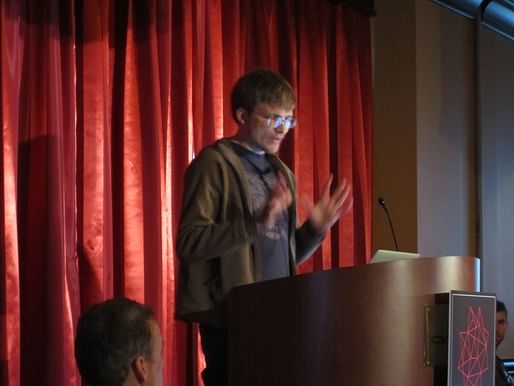
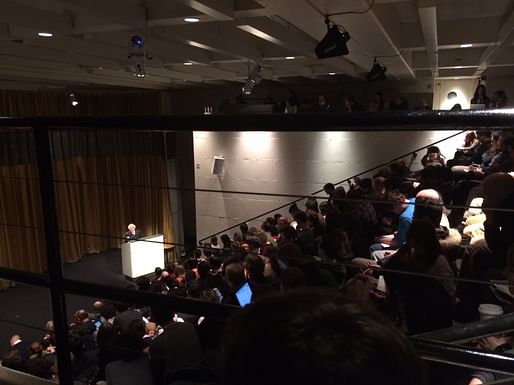
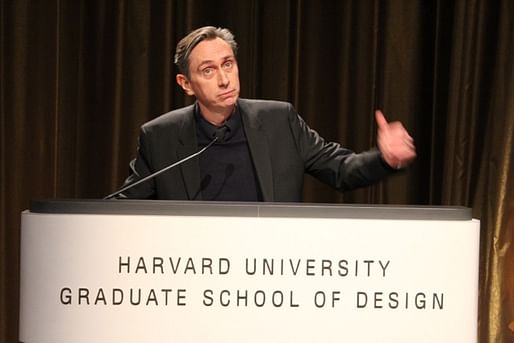
The Return of Nature is apparently a series of symposia held at Harvard GSD in which a historian, a theorist, and a hysterical woman discuss--and I quote here from the official description--"the question of architecture's autonomy in relation to contemporary debates." Each of the three panelists presents a thesis, perhaps positioned polemically relative to the other two, and then engage in discussion: first, among just the three panelists; second, taking questions typically from the bigwigs (or the big haired, in a few prominent cases) in the front row; and third and finally from members of the peanut gallery. These events have been heady and entertaining, and very well attended. The conversations have been a bit too glib and theatrical to get at some of the potential intersections between the three presentations in an orderly (and therefore accessible, for us little peanuts) manner, but overall they've been pretty exciting.

One of my professors, Michael Hays, was on the panel tonight and I thought he gave us a very lucid and touching moment in a response to an audience question. This is a very loose paraphrase, but what he said is that the reason why he's so interested in the sublime (a topic to which he's returned frequently this semester in his lectures) is because in a world where everything has become so ever-available and immediate, it has to do with negative reasoning, in that it calls up and faces that which is absent. In this anecdotal and rather garbled form, this may not seem like that profound of a comment, but coming at the end of an event that saw both a good amount of high-level discourse as well as tussling egos and extravagant claims, this very simple and heartfelt statement of one person's position somehow struck a chord with me.

Anyways. That was the third installment of this series, but we have not yet had the second, which unfortunately had to be postponed. But I really hope to see Liz Diller, Mark Jarzombek, and Andrew Payne up there at the front of Piper auditorium sometime very soon.

image image
Open House Edition, Part Two
Hello Archinect,

I wanted to follow up on last week’s post with some thoughtful prose about the GSD, my experience of it so far, and what I’m learning. But—and maybe this is the best sign that I’m starting to be a real architecture student—I can’t seem to muster up the words. So I’ll show you some images and will try to narrate them the best I can.

The best way I can describe what it’s like to be here—and this probably goes for most architecture schools—is that it’s like a really advanced kindergarten. Or maybe a really rigorous one. We play, we invent, we get immersed in our own fantasy world, and we push ourselves so far that the normal conditions of the civilized adult world cease to apply and only a thin shell stands between us and a temper tantrum or, say, complete loss of continence.

With this in mind, here is a time lapse video, taken by one of our TAs, of our class setting up our inflatable projects for our materials and construction class which ended a few weeks ago. [follow the link for the video: ]http://www.youtube.com/watch?v=Kqwe5eqf0Z4] The giant one at the front totally rocked—this team was the only one that realized you could create air locks and actually inhabit the inflated structure. To keep it together, so that the air pressure didn’t just push the plastic out into a more or less spherical blob, they built these tensioning elements (like columns, but acting in tension) that cut through the space. This created strange orifices on the exterior that passed completely through the structure but which you couldn’t see through without moving them with your hands, since the air pressure from the inside closed them off. image

It’s also a giant playground because every day there are all kinds of events, most with eye candy, food for thought (and often food for the belly), and opportunities to see and mingle with Important People, or indulge in perfectly uneducational play with absolute seriousness.

image
image
image
image [The above is Dean Mostafavi speaking the opening of Le Laboratoire at Harvard, which is run by scientist/artist David Edwards.]
image [This is Mark Jarzombek from MIT responding to Marcel Meili's talk in a symposium on Materiality + Construction in Swiss architecture that is going on at this very instant.]
image [This is my desk space.]
image [This is a party.]

But let’s settle down for a moment and talk about the work. I had a little mid-term discussion with my studio prof (Danielle Etzler from SHoP Architects) about what I should work on for the rest of the semester, and we talked about wanting to be more deliberate in achieving something specific through each artifact, whether it’s a drawing or physical or digital model. So I need to strategically deploy my (limited, but growing) skills so that each representation is not just trying to “show the project” but is a testing ground to develop a complete thought. This thought should neither be identical to nor developed in a linear fashion from the previous thought, but instead stand in a kind of genealogical relationship to it, so that at the end of a project I’ll have a series of artifacts that document the development of an idea over time. It’s basic, in a way, and it’s something we talked about quite a bit in my History and Theory program at McGill, in terms of the history of representation—but actually doing this in studio on a daily basis is another story. So wish me luck!

image [This was my desk crit from yesterday, one week into the "Locks" project: analysis of one artifact so I can extract its essential juices to congeal into a new form.]

Before I go, a few more pictures. Here is the review for our third project, which was called “Hidden Room” and for which we were only able to present our ideas through two plans. image

Our critics are so passionate about the work and about our pedagogical adventures that they get pretty excited in their conversations, to the point where sometimes they forget that there are sixty students standing or sitting behind them, trying to see and hear what’s going on. So much of the review looked like this. image

And this last picture encapsulates everything that I find wonderful and frustrating about the GSD. I’m sitting in on an class taught by Sanford Kwinter that I find pretty awesome—it’s about the last 30 years or so of architectural theory, which is really crucial to understand where we’re at today in terms of parametrics and fabrication all the software we use. But this Wednesday was Veteran’s Day, and the GSD doesn’t take a coherent stand on these kinds of minor holidays, so what ends up happening is that we all have classes but without the normal technical and logistical support—and Kwinter has to show his slides on his MacBook Air. Those of us with laptops were able to follow along on our own screens, so it wasn’t a complete loss, but still. image

Thanks for reading!

Lian
Open House Edition, Part One
Hello Archinect!

Well, we’ve finished four short (12-14 days each) projects and are just starting our last one for the semester: a building/pedestrian bridge integrated into, and more or less based on, one of three locks that sit at the mouth of the Charles river. I say “more or less” because although these locks create very specific site conditions, the project is not supposed to be driven by site so much as by more formal architectural conditions related to the mechanism that allows for a transformation (that is, literal movement) between two states—the first allowing passage for boats and the second for pedestrians. The project brief also gives only a very loose idea of program, simply stating that about 60% of the building’s area should be for public areas for assembly, and the other 40% for back-of-house functions.

The project is in this sense representative of this first semester of the M.Arch. I in particular, but also of our architecture department’s culture in general under P. Scott Cohen. That is, although we engage site and program and the whole range of concerns that relate to design, what is often central is the question of form and of generating form in a rigorous (rather than based on more personal aesthetic preferences) manner through the use of geometry. We also generally do this in the context of buildings, rather than through abstract exercises or through objects of other scales or natures.

This seems like a good time to take stock of my experience here so far for two reasons. First, our studio critic asked us to write a bit about our intentions, our efforts in terms of representation, the criticism we received at reviews, and what we’ve learned, for each of the projects we’ve had so far. That’s because we’ve done these four short projects and are now heading into a longer one—a full five weeks—and particularly because this project is fairly open-ended, we need to have some clarity about where we’ve come so far and what we want to work on for the remainder of the semester.

The second reason is that the GSD has its Open House for prospective students today, I’m excited about that! I’m really happy to be on the other side of the table now, as it was exactly one year ago that I attended this same event as a prospective, but the whole school shopping and admissions process is still close enough in my memory that I can totally empathize with what these visitors are going through.
So right now I have to head off to lunch and to a student panel (in which all faculty members leave so the prospectives can ask a group of students any questions they want in a slightly different and more casual setting). But I’ll post again this weekend with some thoughts about my experience here so far. For now I can say that it’s been really intense, and probably the most difficult thing I’ve ever done, but I feel like I’m starting to find my bearings.

Thanks for reading!

Lian

P.S. I sometimes get emails from prospective students asking about how they can work on their admissions package or how I ended up choosing the GSD. I find this really difficult to answer because every person has a different background and aims for graduate school, so factors that were crucial for one person might not matter for the next person. But I’ll try to think about this for my next post too.

P.P.S. Here is the fruit (in the singular; the only thing we were to present at the review was a physical model) of my labors for the last project.

image
Second Project Done.
Hello Archinect!

Our second project, which was a house in a 7.5' gap between two existing gable-roofed houses, is finished. It was great to see what everyone came up with; this project required formal invention much more than the first one, which was more analytical, so there was a great deal of eye-candy on people's desks and at the final review.

I'll try to get permissions and files so I can share text and images from other people's projects here, too (any classmates reading this, please email me with your stuff if you're willing), but for now mine will have to do.

Although we also wrote longer descriptions, we were asked to encapsulate our design intentions in a 144 character statement, as a way to guide our work in the project's second week. I wrote: "When oriented such that one moves vertically into, through, and out of a mass, how can passage through a dwelling be marked by light?" My line weights (among many other things) leave many things to be desired, but I was happy enough with the result for now.

Here it is--thanks for reading/looking!

image Floorplans, from basement (shown at the bottom) to the roof garden/pavillion (shown at the top).

image Short section.

image Long section.

image A monolithic barrier, which you pass under to enter.

image Model. This is the back of the house.

image Model, with the adjoining existing house removed.

image Model rearranged by floor.
"Psychoanalysis with twenty people on the couch at once"
Oh goody. Preston Scott Cohen is grilling Thom Mayne in Piper tonight. He asked him about style. Mayne, presenting himself as someone who solves problems and steers a process without a priori formal notions, said "Oh, I don't think about style. I'm very ambivalent with aesthetics." PSC said "But why does this building (the Cooper Union project) look like that? Can you tell us about that?" Then Mayne said "it has to be that way. That's the only way it can be." PSC said "Oh really." He then proceeded to crit the facade's changing nature, from volume to a surface of one kind to another (folded, cut, etc.), and said "now this is voluntary." He also described the facade as "hiking the skirt" and asked "now, why do you hike the skirt?" And so on. He was drawing on the facade to make his point. He is not letting Mayne off the hook and I love it. It's the opposite of the kid-glove, being nice to the 80 year old man treatment that Mr. Gehry got last week.

[Addendum as of October 2: On a more fun note, I forgot to add that later in the discussion, partly in response to a question from the audience about a project that the questioner perceived as "sensual," Mayne said something to the effect of "that wasn't it at all; I don't think about sex." All I have to say about that is that you should never trust a man who claims not to think about sex (or an architect, about aesthetics.)

image
Frankly Speaking
Hello Archinect!

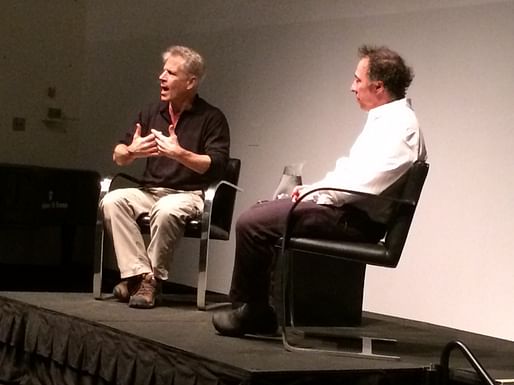
A couple of quick notes from the Gehry/Brown conversation in Piper tonight.

image

Joe Brown is great, but he is very PC and says the right thing; Gehry is more, well, Frank, so the notes and quotes I jotted down are from him:

Gehry started by talking about how it's important to "stay parental" as an architect; to find ways to maintain control of a project. He discussed/praised Dessault CATIA (which he used very early on) in this context. Then he observed how students are "all" using Rhino and how the challenge is to "keep the humanity" when trying to negotiate the complex process ("which goes through thousands of people") from your "dream image" to a built project.

Brown asked Gehry what his most important accomplishment is. Gehry starts by sidestepping the question with humility (whether genuine or feigned, but it seemed honest) and talked about the fact that he still has "a healthy level of insecurity," that he's still "scared and hungry and on the run looking for the next project.” He then adds, "let’s get rid of all the bullshit about starchitects and all that crap," and advises us to not follow fads. He then talks about how he's proud of his work with clients, schedules, budgets, that "most of the projects don't leak," and pronounces that “it comes down to personal relationships, which it always does, in any business… which can be difficult, because people have family problems, psycho problems, drug problems, kids.”

Thanks for reading. Good night!
Lian
Project 1 done. Project 2 starting.
Hello Archinect!

It’s been three weeks since my last post, so I apologize for my absence. I’ve been busy! Our first studio project—the addition of an elevator to a 19th century building with convoluted staircases and other circulation patterns—has come and gone, and our class is fully immersed in life at the GSD. Our second project is a house in a very constrained site: a narrow gap between two nearly-identical gable-roofed houses, a few blocks from school. I’ve always been fascinated by small spaces: One of my favorite apartments was in the University of Alberta’s HUB Mall, an enclosed arcade connecting various university buildings with a long pedestrian street of shops and restaurants and apartments overlooking them. One of the most common unit types had four bedrooms off a shared double-height space; each bedroom was under 20 square feet, and after a quick trip to IKEA, it was perfect. (The key was making use of the vertical space with the loft bed, a strategy aided, I’m sure, by the fact that I’m not particularly tall.) All this to say that I’m excited to see what we can all come up with for this tiny and very demanding site.

The school's teaching, resources, curriculum, and the overall administration have been really impressive so far. I love how it’s a big place filled with obsessive-compulsive designers and nerds, such that there’s a system (and often an algorithm) for every decision-making process. It’s not perfect, but the GSD is a big enough (and good enough) ship that even with a few leaks here and there, constantly being patched, it sails just fine. Of course, there have been frustrations, too—mostly involving a certain early-morning class which is mandatory and for which we have to sign in at the door, but for which we do not get credit, and reviews for non-studio courses which go on and on and on and on—but these are small issues. What these two examples suggest, however, is that the way to tick off the M.Arch.I class is to rob us of our time. Time (and therefore sleep) is the currency that rules our lives, and in which we’re always running short on. I’m sure most architecture schools are like this (and I’d like to hear about it from the other current and former M.Arch.I students out there), but it does seem particularly insane here. We have studio on Monday, Wednesday, and Friday, so we essentially have some kind of deadline three times a week, and combined with our in-class time and homework for our other classes, and the various workshops, lectures, and other non-credit (but pretty much mandatory) activities, plus all the really great extra-curricular stuff going on, every hour of the day and night seems to be accounted for, and we’re often double and triple booked.

The biggest change for me, coming from a PhD program, is learning how to learn a little about a lot, rather than a lot about a little. Nothing that we’re doing is all that difficult, but there’s just so much to do. The GSD’s approach, at least in the core program of the M.Arch.I, is to throw way more at you than you can possibly keep up with, so that you learn to prioritize and make choices. Scott Cohen told us not to worry if we can’t follow everything in an in-depth manner, that the key is to pick up on whatever clicks for us and find ways to cultivate our own areas of interest and expertise over the 3.5 to 4 years that we’re here. I’m taking that to heart and am keeping the perfectionist side of me in check; everything is an opportunity to learn and my aim is to focus on what I am learning rather than whatever I may not have been able to learn or get to on any given day.

In terms of studio pedagogy, the compressed schedule and frequent meetings with our studio critics and TAs are set up so that we’re constantly being asked to produce. If I have to do (say) a model in Rhino for Monday, a set of diagrams, plans, and sections, for Wednesday, and a physical model for Friday, I don’t have time to sit back and contemplate the project. So I have to learn how to think through making and to develop my own working process for doing this. While this can get hectic and stressful, I really appreciate this strategy. It seems to set up a condition comparable to that of architecture itself. A building can’t do everything well; if it tried to do that, it would probably achieve nothing. So we have to pick our battles and try to find ways to deal with a few essential ideas at a time, within the many demands placed on any given project.

I’ll leave you with a few pictures.

image
Here’s a group project (with James Martin and Bri Patawaran) for our structures class.

image
Here we are in Corb’s Carpenter Center.

image
Here’s Scott Cohen doing his thing (photo credit: Glen Santayana).

image
And here… is our site for project #2. That’s right, it’s the space between these two houses. I’d better get back to work!

Thanks for reading.

Lian
Orientation Week
Hello Archinect!

We’re just over half way through our pre-semester horse and pony show at the GSD. It’s a long haul. On Wednesday we had international student orientation, on Thursday was a general orientation, on Friday we had more presentations and facility tours, and these will continue on Monday and Tuesday, along with the studio and course presentations and lottery—which promise to be exciting, even though we lowly first-years can only “look but not touch.” Before I start, I also have to apologize to my classmates for being so grumbly on Thursday and Friday—I need to get more sleep and/or (probably “or”) just deal with it better.

Here are a few highlights from Thursday.

Mohsen Mostafavi, our dean, spoke first. Predictably enough, he emphasized the breadth of the GSD’s offerings, which he divided into studio-based (e.g. M.Arch., MLA and MAUD) programs, non-studio based (e.g. DDesS, PhD) programs, and other initiatives (executive education, exhibitions, other programs) that reach out to a wider audience. He also talked about transdisciplinary nature of the GSD, which includes Architecture, Landscape Architecture, and Urban Planning + Design.

Then for the pep talk: we heard how we are here not just for “skill-building,” or “to learn about how things have been done in the past,” although he acknowledged that both are essential, but that our goal as GSD students is ultimately “the advancement of the discipline” and to engage the speculative aspect of practice. In a more philosophical moment, he also talked about the use of technology in terms of investigating the “mediated imagination,” or in the means through which we make our ideas come about. And he mentioned sustainability as an area in which we (as a profession and as a school) have no choice but to be leaders.

A couple of fun initiatives that Dean Mostafavi mentioned. First: a publication called “View” that includes one page of work from any person at the GSD (faculty or student) who wants to contribute. And second: a series of “occasional lunchtime discussions” that he will lead, most often with people who are not architects but who deal with issues surrounding art and architecture. I’m glad that he isn’t shy about embracing fields peripheral to the discipline, as I think this can keep things interesting and add intellectual rigor.

We then broke into our departmental groups, and we heard from Preston Scott Cohen, the chair of architecture. He immediately drew a contrast with Dean Mostafavi’s emphasis on breadth and interdisciplinarity by saying that our department is “unapologetically architecture-centric, and that’s how it’s going to be.” Our four (yep, count ’em, its longer than most other programs) semesters of core each have a theme: “Technique,” “Material,” “Politics”—and something called “Ecology,” whose name he said is currently under dispute. I thought the four themes were “Rhino,” “Rhino,” “Rhino,” and “Rhino,” so this reassured me (even if perhaps it shouldn’t have).

Scott Cohen also gave us a pep talk about thesis, saying that each year’s theses are “a big deal” in shaping the school, and that thesis is not as far away as we think. He described a curricular change for the thesis prep course: whereas there used to be an independent course that each student pursed with their faculty advisor, we will now have an extra elective which we are to select and use to help shape our topic. Having helped teach the M.Arch. thesis prep course at McGill, and having spent over a year and a half defining a research topic for my own Ph.D., I think this new system rocks. It’s incredibly difficult for an M.Arch. student to define all the constraints for a project within a well-articulated intellectual and creative framework, since as a task this is very different from what the rest of our training prepares us to do, so it will be very helpful to think about our thesis projects as building on an existing course from the GSD (or a cross-registered course from the rest of Harvard or MIT).

But this is not the only model for thesis projects: we also heard about the directed thesis program, in which the faithful (and lucky—I think these are popular) get to cast themselves at the feet of practitioners such as Rem Koolhaas or Herzog + de Meuron as slaves for a professor-led group research project. Scott Cohen then brought all this thesis talk back home by telling us that the core program is intentionally overwhelming, and that we shouldn’t try to cover everything equally. Instead, we should notice and cultivate the fact that we’ll pick up on some things and not others, and in so doing, start developing areas of competence and interest that we’ll eventually be able to tap into in our theses.

Scott Cohen then mentioned a series of symposia this semester that will look at the theme “The Return of Nature.” We’ll see what actually happens, but it sounds like the aim here is to think about how the idea of “nature” is used today, both in the discourse of sustainability and in the practices of computation which often render “biological” forms and attempt to mimic non-formal biological processes. The question seems to be about where the work of architecture will reside in our time, if not in the autonomy of art (as in modernist formalism)—or, I would add, in the symbolic metaphysics of traditional architecture prior to the 19th century. The symposia might, in this sense, be a kind of corrective (or complement) to the “Ecological Urbanism” conference held at the GSD in April, in which about 75% of participants masturbated at the altar of biological empiricism and computationally derived form (aka ornament) while the other 25% loudly denounced these practices as they attempted to gain the moral high ground by insisting that we simply all ride bicycles. Not that there’s anything wrong with bicycles—but I’d like to think that architecture is not just about reducing our carbon footprint by riding them. The symposia’s sub-title is “Organicism Contra Ornament” and you can read the full description here: http://www.gsd.harvard.edu/events/pdf/return_of_nature_description.pdf

This semester promises to be a bit insane: on Thursdays we have 15 minutes off between 10am and 6pm—and that’s our easy (non-studio courses) day. So I’d better sign off now, and just leave you with a few pictures.

image Here is Jeff, who illustrates children's books and who works for the GSD putting up exhibitions. He's putting up a show on the utopian aspects of Kenzo Tange which was organized by a GSD PhD student, Seng Kuan.

image Here's some work for the Chinatown Library project, which was a student initiative for which the GSD ponied up cash. http://www.gsd.harvard.edu/news/chinatown_library_project.html

image Here was one of our info sessions--this one was on Harvard's health services. We had these nifty little clickers with which we could give our responses to multiple-choice questions that she had for us. Our answers came up on the screen as a graph and, besides being nifty, this is probably a good source of statistics on incoming international students for the health services people.

image Stephen Hickey is showing us the very scary and impressive water jet robot.

image If you're wondering why I think a little squirting water is so scary, this is what it does to marble.

image The water-jet robot and the giant tub of sludge that is used to dissipate the energy it produces.

image A smaller and cuter version of this robot, with a metal-folding project some students completed with it.

image The GSD doesn't want us to lose fingers, so the table saw has a nifty sensor which can detect the greater electrical conductivity of human flesh, which causes the blade to immediately retract. This makes me happy.

image The Materials Collection has all kinds of cool stuff, including LiTraCon, which is a brand of concrete that uses fiber optics to allow it to transmit light.

image In the Materials Collection.

Thank you for reading!
Lian
This makes me very happy.
I printed out my dissertation today and put it in the mail, so now I can focus on my schoolwork and getting to know my new friends here!


image
My first project = your comic relief
Ok, today was the second day of the digital skills workshop and up until this point, were were supposed to model the Rietveld Schroder House in Rhino, mess around fitting it into its site, and then do some interior renovations to adapt it for two occupants--a "misanthropic academic" and a more fun-loving artist.

That was a pretty tall order for me. Like some of my other more technically challenged classmates, my original model was sadly incomplete and messed up, so I borrowed our instructor's model of the original house and just made renovations from this file. As such, my "renovations" consist of cutting a few walls, adding a few others, and punching a hole in a floor-plate. Nonetheless, I'm pleased enough that, for your enjoyment and my future nostalgia, I thought I'd post the results.

Here's me figuring out my scheme.
image

Here's the model in Rhino (if you're thinking "that's not so bad," remember, almost all of this is from the model our instructor made).
image

Here's a plan of the first floor. woooohoo.
image

Arright, gotta go work on my dissertation--it's due in 5 days. Thanks for reading!

Lian

Search School Bloggers:
Search Blog Entries:
All entries from this blog: