

This article by Laura Burkhalter and Manuel Castells explores the urban dimension of the current economic crisis, describes the failure of the city forms developed in the 20th century, and outlines a series of alternative proposals on transportation, housing, public space, and urban planning, to manage the crisis while improving the quality of life in the 21st century metropolis.
The global economic crisis has its roots in the speculative connection between the financial market and the housing market. The speculative schemes collapsed when the real estate bubble burst and the insolvency of the lending institutions was exposed. It followed the calling into question of the urban growth machine that has produced our flawed built environment in the last half century. Indeed, the crisis is not just financial or economic, but environmental, social and functional as well. It is the crisis of a model of urbanization that is not sustainable.
However, the depth of the crisis offers an opportunity to rethink the metropolis and to implement new urban planning strategies focusing on people´s needs and desires, and on environmental conservation, rather than on short-term profit.Thus, in this emergency situation we feel compelled to engage a debate on the new ways of urban planning and urban policy appropriate for the 21st century city, both to manage the crisis and to change the metropolis beyond the crisis. However, the depth of the crisis offers an opportunity to rethink the metropolis and to implement new urban planning strategies focusing on people´s needs and desires, and on environmental conservation, rather than on short-term profit. In this article we present a series of proposals having in mind the polycentric metropolis. We are not indulging in urban dreams, even if some of our proposals would appear to be so. We are proposing, as illustrations of a new urban way of thinking, a number of concrete initiatives in transportation, housing, public space, and urban planning at large, that, together, could open the path towards new spatial forms of living. We present these proposals, deliberately, in a tentative form. They are sketches rather than closed urban models. This is because they are intended as ideas to debate, as tools of intellectual innovation that we believe is previous to any action. Precisely because the situation is so serious, and the urban crisis so deep, we cannot afford to react without thinking. Indeed, investing more resources in the same urban model will lead to the same failed consequences, thus amplifying the extent of the crisis.
↑ Click image to enlarge
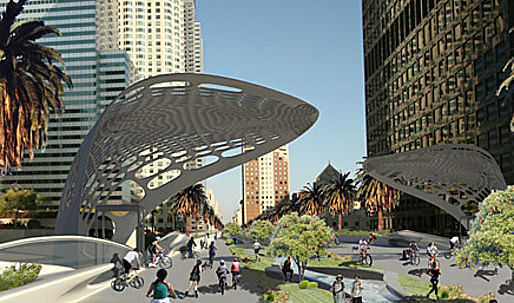
Multi-tiered transportation artery w/bicycle freeway & linear park system as top tier
As part of an urban recovery plan we project a multimodal transportation system layered above the current automobile dominated transportation arteries and accessed via a network elevator nodes and feeder paths. This proposed system would effectively create bicycle highways and bicycle freeways and linear multiuse parks above the existing automobile thoroughfares and freeways for a complete network of safe, compelling and fast people powered transportation system. The space between the upper bicycle freeway and the lower automobile freeway may be used for high speed monorail lines for effective mass transit that is connected to the bicycle freeways as well as automobile routes and can complement their use.
↑ Click image to enlarge
Multi-tiered transportation artery w/car freeway and monorail as bottom and central tiers
Another drastic and equally urgent proposition is the complete overhaul of the current zoning ordinances. We propose to replace these outdated spatial organization systems with new performance criterion that would allow for mixed use urban vitality throughout the city and require high environmental performance, while valuing economic, social and aesthetic benefits to the community creating buildings and facilities that add to the quality of urban life.
The current housing stock, much of it in financial bankruptcy, should be reorganized under various forms of cooperative housing and community managed mortgages with the support of the federal government. The re-use of housing to increase shared living in the existing under-utilized units could be made possible by the proposed revision of the zoning ordinances and would better reflect the current demographics and the new typology of families in our society.
In a similar vein, we propose a network of distributed public space adapted to the existing city, emphasizing spontaneous interaction and multi-functionality. Used public space and a pedestrian friendly environment will be effective antidotes against fear of the other that frequently dominates the experience of urban everyday life.
Flexible planning and citizen involvement in urban governance will make possible the implementation of innovation in the way we build and manage our cities. The proposals submitted here are technically feasible, not utopian dreams. However, they can only become materials for a new form of urban planning under the condition of grassroots mobilization and a change in urban politics. By communicating our ideas for a new urban economy and a new model of city we hope to contribute both to a renewed debate on urban policies and to a process of community mobilization, the fundamental lever of urban transformation. In the midst of a devastating crisis we are planting the seeds of hope for a better urban life beyond the crisis.
Read the full article as PDF here.
Laura Burkhalter is the founder and director of the Institute for Bionomic Urbanism (IBU), a new non-profit organization and think tank developing a more holistic urbanism in practical application and in theory. She is also the principal and founder of LBDS LLC, her client based architectural design practice.
Laura Burkhalter was born in Switzerland and has been living in Los Angeles for over a decade. She received her architecture degree from SCI-Arc (Southern California Institute of Architecture) in 2000, graduating with the highest honor award.
Manuel Castells is a sociologist associated particularly with research into urbanism, the information society and communications. Manuel Castells is one of the world's most highly cited social science and communication scholars and has written more than 20 books, including The Urban Question (Original publication in French, 1972) and the influential and monumental Information Age trilogy (The Rise of the Network Society , 1996; The Power of Identity ,1997; End of Millennium , 1998). His most recent book is Communication Power (Oxford, 2009). He is a professor emeritus of city planning at UC Berkeley and University Professor at the University of Southern California, Los Angeles. He is also associated with the Barcelona Institute of Architecture, and with the California Institute of the Arts. Manuel Castells lives and works in Los Angeles and Barcelona.

16 Comments
These are very beautifull also nessery visions but to focus on the barriers, what make the difference between vision and direction, then it is very trivial issues making the difference. If we can't build cheaper many visions will fail, on the other hand, if we could allow a complete revolution in how to manufactor structures, if computers was realy and by core allowed to project and calculate the pieces, -- even in a scenario where most designing was trusted to computer programs and algorithms, to ensure building and structure compoments cut and made by digital guide -- if we could realy build completly free and gurantied for a third the cost and many times stronger by calculated assembly, --then all this would be avaible. Only if the engine from the old Ford A is not just made perfect to the extends, and placed in a newly designed hulster no when hat engine are replaced by something quite different when we jettison the methods that was good enough for two hundred years, and take the next step.
I allway's had the attitude, that when the method is there, when the first innovative aproach has proven this to be possible, then this design thing, this projecting our surroundings with thought and arts, would come all by itself. That when people realised that there are new way's to realy generate the building parts in a new way, making it possible to build whatever can be drawn in a CAD program, that when you can point out a design projected 3D on a screen, and make the computer maneage to calculate the pieces, knowing exactly their posision, that then we would see a new architecture, ---
That is exactly what hold back so many visions crunsh so much possible beauty and so many great wonders newer seen before, our expertations that a visionary must spell a perfect english, Sorry I don't, but something allway's held back the only right solutions.
It is sad despite Laura Burkhalter claiming to be developing holistic urbanism, yet she designed this massive pollution additive to the urban landscape. You are delusional if you think people are going to enjoy a nice cup of cappuccino above an exhaust fumed busy highway (pictured above). Architect needs to think like problem solver that imagines built solution, rather than builder that gives form. STOP THIS LUNACY !
yet enjoying a mochachino double grande latte in the heart of one of the most polluted cities in America is a.o.k, right???
get over yourself.
word
I see this type of infrastructure/living area conglomerate a lot lately. I think it must be actually happening somewhere, but I don't know where. I would like to see the real thing, it might be great, or it might be stupid. I do not know if I would take my latte on that thing or not. I would definitely try it once. These projects tire me out a little. I like a nice chair. A small bonus for whoever happens to sit there. Save the city one ass at a time. I don't know. Cool idea though, every time I see it.
Couldn't open the pdf on blackberry so I am assuming details I feel unanswered must be presented therein.
Co op living, I like this idea not because its a socialist ideal but because co ops keep architects very well employed. Whenever a bunch of people live together and democratically make decisions, there's bound to be lawsuits and arbitration requiring a mediator who both understands the law and construction.
The gist of what I read is very top down thought, although claiming bottom up. If you want housing to be different it can't be a commodity anymore, zoning won't solve this...maybe a ridiculous tax structure making it impossible to earn money from developing real estate would work, but that's just ridiculous to even ask Americans to do that.
Univerisal infrastructure like communism is too ideal to work. Mcdonalds offering EV charging is far more effective than asking people to take the train and ride bikes.
Incase anyone is wondering the weehawken, nj high school baseball and football field is right over the lincoln tunner entrance to nyc.sure its unhealthy now, but when everyone has a EV charged up at mc d's...
How can any of the nations now in crisis pay for this "multi-tiered" transportation system ? Isn't it cheaper to invest in hydrogen technology for cars for example...also, how does it actually work ? if you must go to the second level to enjoy your coffee and then climb down 3 flights of stairs to enter the supermarket at ground level ?? one simpler way to think abt. city building with far fewer resources ( natural resources and fiscal resources ) is to concentrate resources strategically. This means NOT investing in projects in rural areas, increasing FAR in the cities' most desirable areas with conditions for inclusionary housing, etc...Come on, any first year urban planning kid can think of much better ways than these academic "hot shots" !
dear editors,
check the text on the pdf, you have some paragraphs repeated twice over pages 6, 7 and 8
I'll beat anybody's paradigm price or your paradigm is freeeee!
It's a massive stretch to claim that the current economic crisis is somehow a "crisis of a model of urbanization that is not sustainable," which is to say "the urban growth machine that has produced our flawed built environment in the last half century."
Sure, real estate and buildings were connected to the financial melt-down, but lax regulation of derivatives markets and a series of economic conditions that led to a big real estate bubble had much much much more to do with the current economic problems than any urban design and development pattern itself ever did. There was lots of speculation - and now are lots of foreclosures - on homes in high-density multifamily buildings in walkable, mixed-use neighborhoods too you know. Sunbelt SFD subdivisions aren't the only places hurting!
I agree with most of the criticisms already leveled, but I want to point out: just because you claim an idea is not 'utopian' doesn't make it practical and easy to put into action. Similarly, a lot of the proposed solutions seem like putting grassroots lipstick on a top-down centralized planning pig. (Laura and Manuel, you guys can do better!)
However, the pair are spot-on in singling out zoning as an area to be reformed. Much of the North American landscape is car-dominated sprawl by law, and not by popular demand. It's time for that to change.
I agree with scottaway. I believe that the editors brought a debatable alternative, but I also believe that it was limited by the series of rules, policies and speculative theories of urban morphology. Zoning must be rethought, just as connectivity must be rethought. What ever parks and public places in the middle is provided, it is sometimes used. Eventually, I get my cappuccino in places where I think is utopian, but I know that it is not.
aml: Thanks for the hint - the pdf is updated now.
The system has choked.. Radical ideas and smart visions need to be considered seriously so a conversation can be started to turn this country around... Asia and Europe are ahead of us and we need to be able to compete and lead once again...
Intriguing and provocative article…
I love the fresh and bold approach to infrastructure and zoning. It’s not a subject in which I’ve seen many visionary ideas. Most urbanists get stuck on trying to copy the old European city model and therefore create a sort of nostalgic Disney version of European town centers. The proposals in part 2 of this article in contrast depict a new vision of a futuristic and yet people centered metropolitan life. It is appealing in many ways, as it is aesthetically pleasant and conceptually provocative, yet realistic enough not to be discarded as sci-fi paper architecture. I would love to live in a city with bicycle freeways and bicycling as my primary mode of transportation – who wouldn’t? I like the fact that there are still people out there daring to dream big.
right on!
peeps need to think big in these times
This looks like a major urban mistake. Why not just design the roads more responsible for automobiles so that it can accommodate bikes and pedestrians. They have it almost everywhere else in the world. You can enjoy your cup of tea a few feet away from the street if it is designed right, you don't need to completely separate it. When you start proposing things like this, it competes with life on the street level, neglecting all the pedestrian activities below, and acts as much as a divider between neighborhoods as Moses' highways. It's like the high-line on steroids. What's next? A third level for trains?
Block this user
Are you sure you want to block this user and hide all related comments throughout the site?
Archinect
This is your first comment on Archinect. Your comment will be visible once approved.