

ShowCase is an on-going feature series on Archinect, presenting exciting new work from designers representing all creative fields and all geographies.
We are always accepting nominations for upcoming ShowCase features - if you would like to suggest a project, please send us a message.
Background
The clients required a permanent home/office on their small property, located one hour’s drive from Adelaide. A bend in the winter creek that divides the property, creates a billabong (a deep waterhole) bounded by a high rocky bank. A house was required that would allow appreciation of the site without spoiling its beauty, but at a budget comparable with a “prefabricated” dwelling or an “off the plan” developers design (approximately A$220,000/US$175,000).
The Design
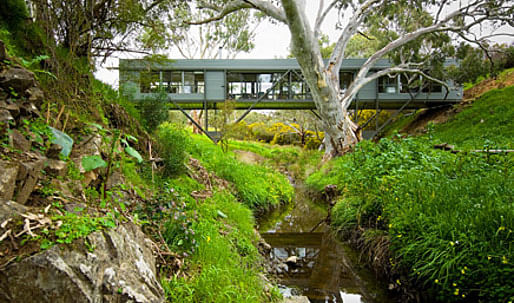
A narrow house form, spans over the creek. Glazing each side opens the house to views in both directions, giving the feeling of living amongst the trees.
↑ Click image to enlarge
Bridge House (Photo: Sam Noonan)
Structure and Materials
Two steel trusses forming the primary structure, were fabricated off site and erected by two men and a crane in two days. They were anchored by four small concrete piers, poured each side of the creek. Spanning between the trusses is a concrete floor slab on steel decking with a layer of rigid insulation. The “box” walling and roofing is plantation pine.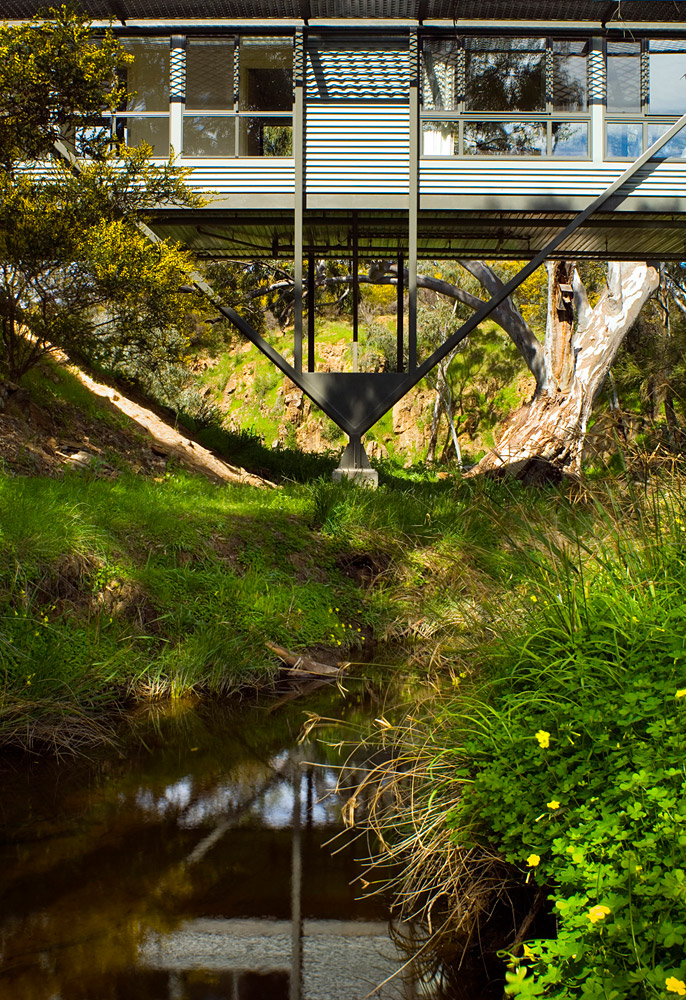
↑ Click image to enlarge
Bridge House (Photo: Sam Noonan)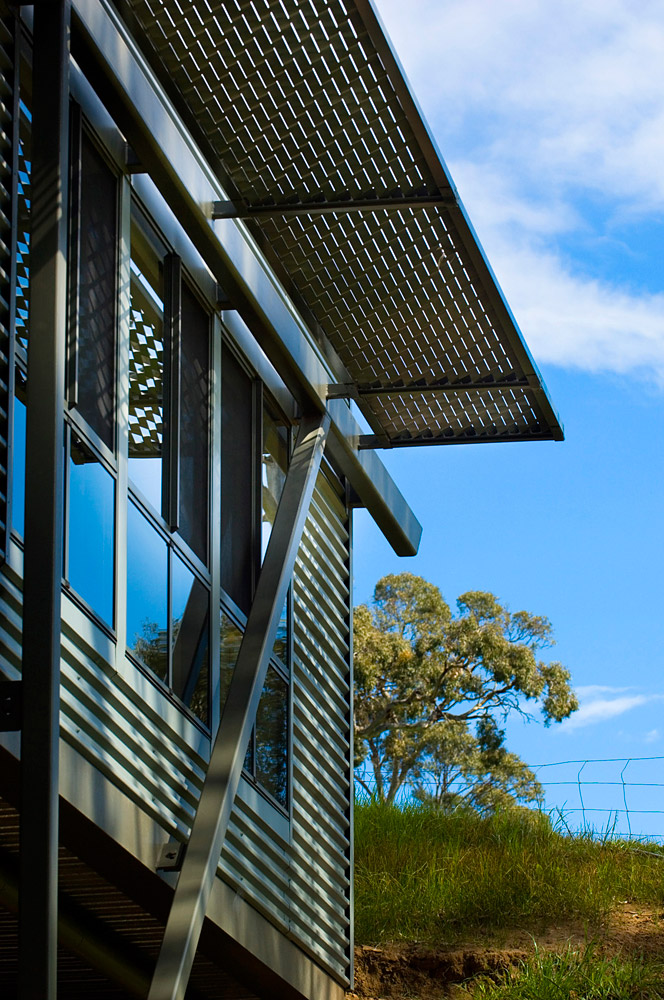
↑ Click image to enlarge
Bridge House (Photo: Sam Noonan)
↑ Click image to enlarge
Bridge House (Photo: Sam Noonan)
↑ Click image to enlarge
Bridge House (Photo: Sam Noonan)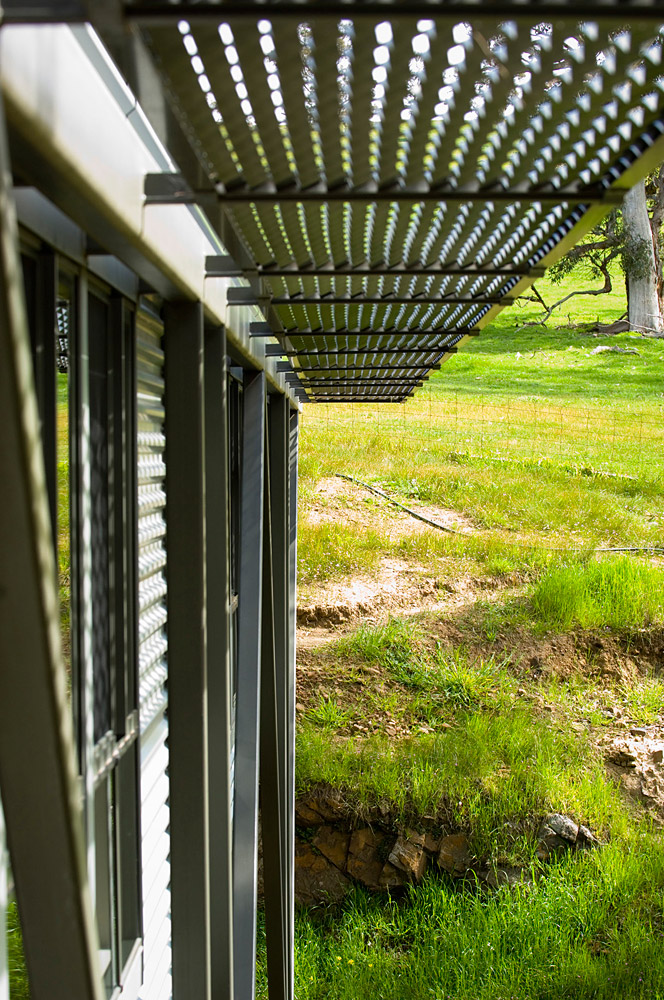
↑ Click image to enlarge
Bridge House (Photo: Sam Noonan)
↑ Click image to enlarge
Bridge House (Photo: Sam Noonan)
Sustainability and Environment
House Size - A floor area of 110m2 has proved quite adequate for the couple‘s permanent home and office. An efficient plan is a simple and effective method of limiting the environmental “footprint” of the building.
Thermal Comfort - This house avoids any air conditioning by the following design techniques:
Steel and aluminum are used in recyclable sections, whilst satisfying the design requirements for bushfire prone areas. Secondary framing is plantation pine grown in the state. Roofing and wall cladding is recyclable sheet steel.
Services

↑ Click image to enlarge
Bridge House (Photo: Sam Noonan)
↑ Click image to enlarge
Bridge House (Photo: Sam Noonan)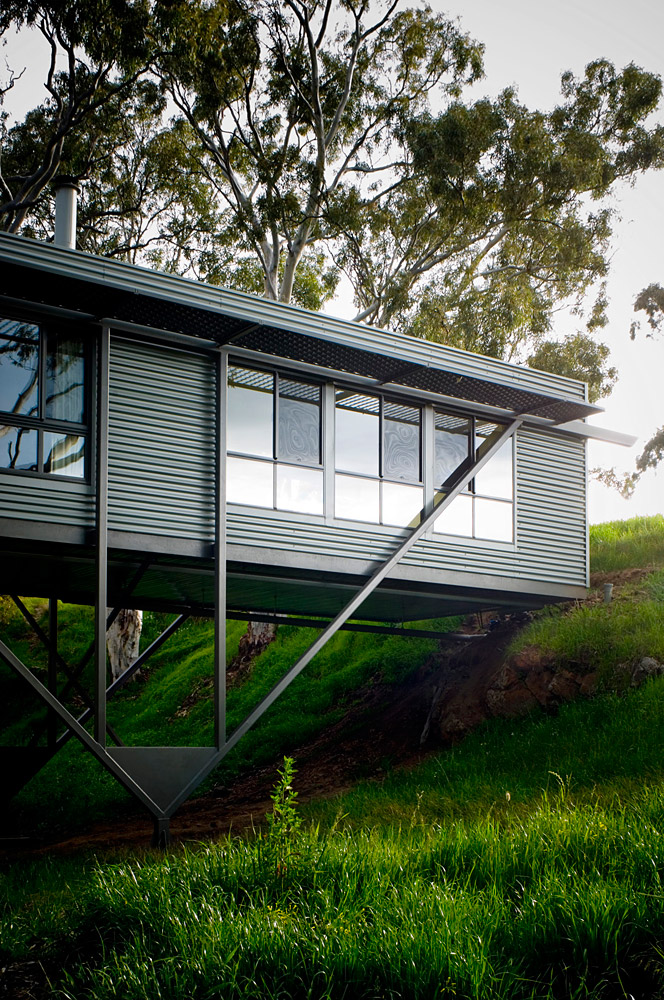
↑ Click image to enlarge
Bridge House (Photo: Sam Noonan)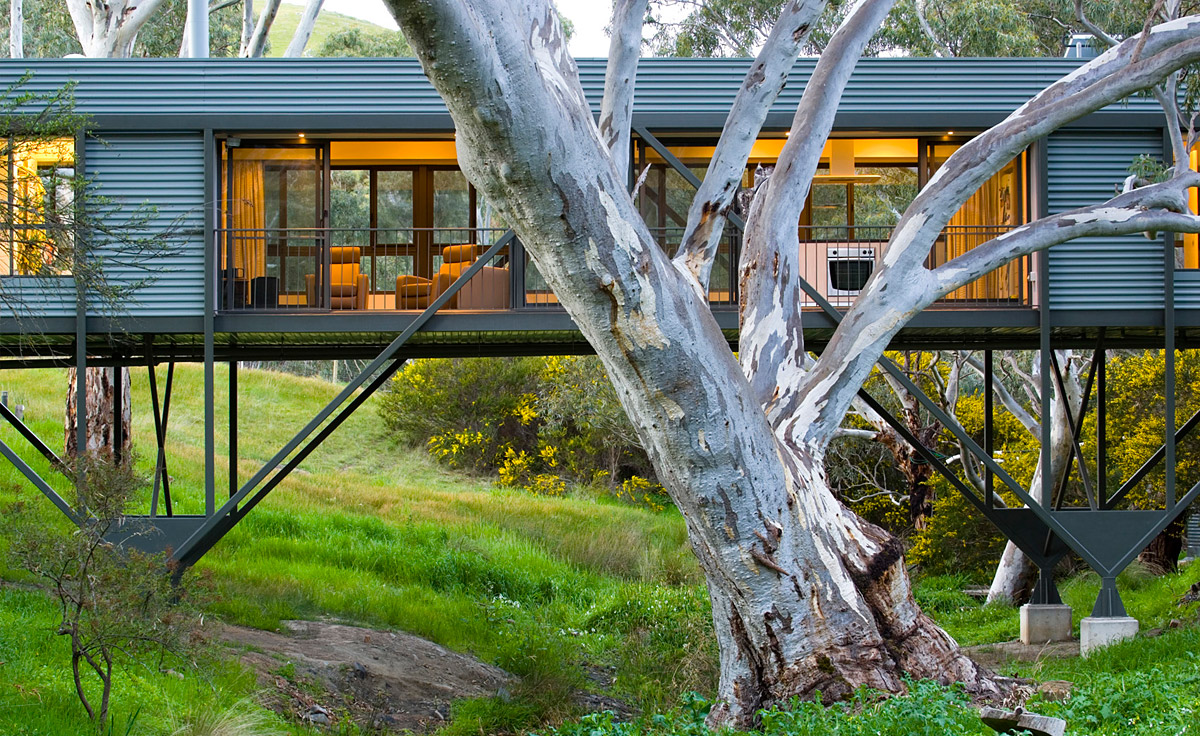
↑ Click image to enlarge
Bridge House (Photo: Sam Noonan)
↑ Click image to enlarge
Bridge House (Photo: Sam Noonan)
↑ Click image to enlarge
Bridge House - Site Plan
↑ Click image to enlarge
Bridge House - Floor Plan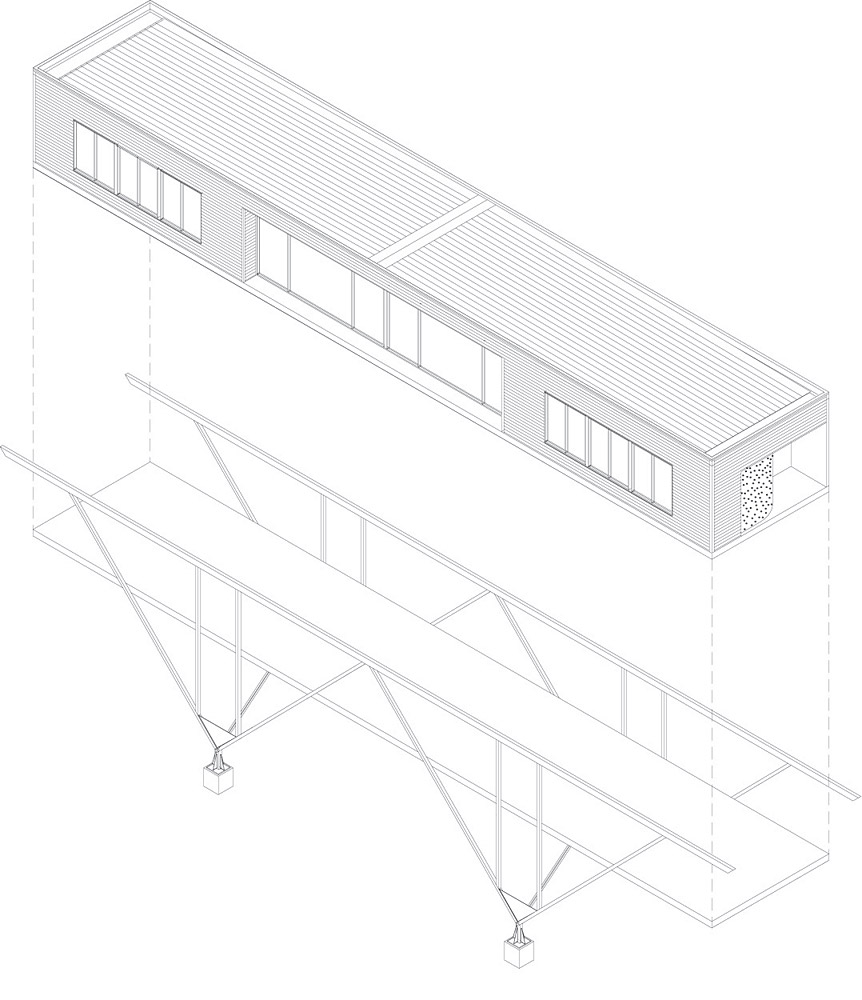
↑ Click image to enlarge
Bridge House - Isometry
Max Pritchard Architect
President's Medal // Maxwell Robert Pritchard
Extracts from citation by Francesco Bonato, President SA Chapter Royal Australian Institute of Architects - on awarding of the President's Medal 2004:
The work of Max Pritchard speaks eloquently of its unassuming creator: deft, grounded and genuine. It is appropriate in a time when the profession is going through a period of self-examination of its role and relevance in South Australia that we recognise a person who has quietly built a reputation and following as an architect of people and place, unaffected by the transient trends and fashions swirling around him.
Max Pritchard's work has been consistently recognised by his peers, having received many RAIA Merit and Commendation awards, and by interstate and overseas architecture critics and commentators.
The essence of his work is that it is as much about the pursuit of good outcomes as the pursuit of good architecture. His houses can be the best examples of architectural excellence as well as affordable solutions for clients simply seeking more than the mainstream offerings of the housing industry. His approach embodies an empathy and humility which in the eyes of the wider community is seen as lacking in our profession.
He grew up on Kangaroo Island where the requirements of the practical led to his discovery of the joy of creation through materials and construction.
After studying at the University of Adelaide in the 1960s he travelled overseas and discovered a world of indigenous housing and construction forms that so suited their physical environment that they influenced the approach to design and respect for climate that characterises his work today.
After a long apprenticeship spent on building sites in various trades and then in a small architectural office, Max stepped out on his own in 1986. The first home he designed received an Award of Merit. Eighteen years and countless awards later, he is the recipient of the Sir James Irwin RAIA SA Chapter President's Medal.
Creative Commons License
This work is licensed under a Creative Commons License .
/Creative Commons License

11 Comments
beautiful. australian architects can kick ass when it comes to nature and residential architecture. it has a lot to do with australian geography and lifestyle.
the sober and informative text is very good.
from the pics, it appears to be a little (maybe couple feet) too high from the creek level. but than again, i have seen these type of creeks go from a foot high to a river size in no time after few days of rain.
the plan is uncanny for me. i am pleasantly surprised and assured of my own decisions you can imagine and little pissed off at my client for not persuing the low-cost building.
craig ellwood is alive...
isn't there a similar work by a Portuguese, architect? But it is in burned out, bad condition?
I love the lightness of this projects footprint..!
Casa del Puente (Bridge House) by Amancio Williams.
Year: 1942 (emerging architecture........)
Location: Mar del Plata, Prov. de Buenos Aires, Argentina.
Amancio williams site:
http://www.amanciowilliams.com/
I didn't think Pritchard's work was about inventing a bridge house.
Stanley Saitowitz Natoma Architects also designed a bridge house, in Marin:

via SpaceInvading
I actually saw this when I was a student. My memory tells me it was much nicer that day than in pictures...
Columbus Regional Hospital Mental Health Services;
Designed by James Stewart Polshek in 1972, the two-story building spans Haw Creek and is based on two offset rectangles. On one bank is Columbus Regional Hospital’s main campus and on the other is a city park and part of the 19 miles of People Trails. The site was chosen for its serene setting.
i think this projects greatest accomplishment is creating something of merit within the budget of a typical suburban home. too many times do i get lectured on cost if i attempt to even slightly vear off the beaten path. good job, i think its a great design.
Isn't it a craig ellwood project?

I've been thinking about bridging a stream with a reposessed mobile home and renovating with beautiful sustainable materials. 'Course I'll need to find a narrower creek and someplace far away to pump the effluents :) richmon
Block this user
Are you sure you want to block this user and hide all related comments throughout the site?
Archinect
This is your first comment on Archinect. Your comment will be visible once approved.